3D in the browser· Client work
Space visualisation
The room, before it's built.
A store, a room or a fit-out, open in the browser before it's built. Walk it, change it, and every answer is a link.
- For
- A Czech retail chain
- Rooms
- Five shops
- Runs on
- Desktop and phone
- A still
- 8.1 s, not 2 min 20 s
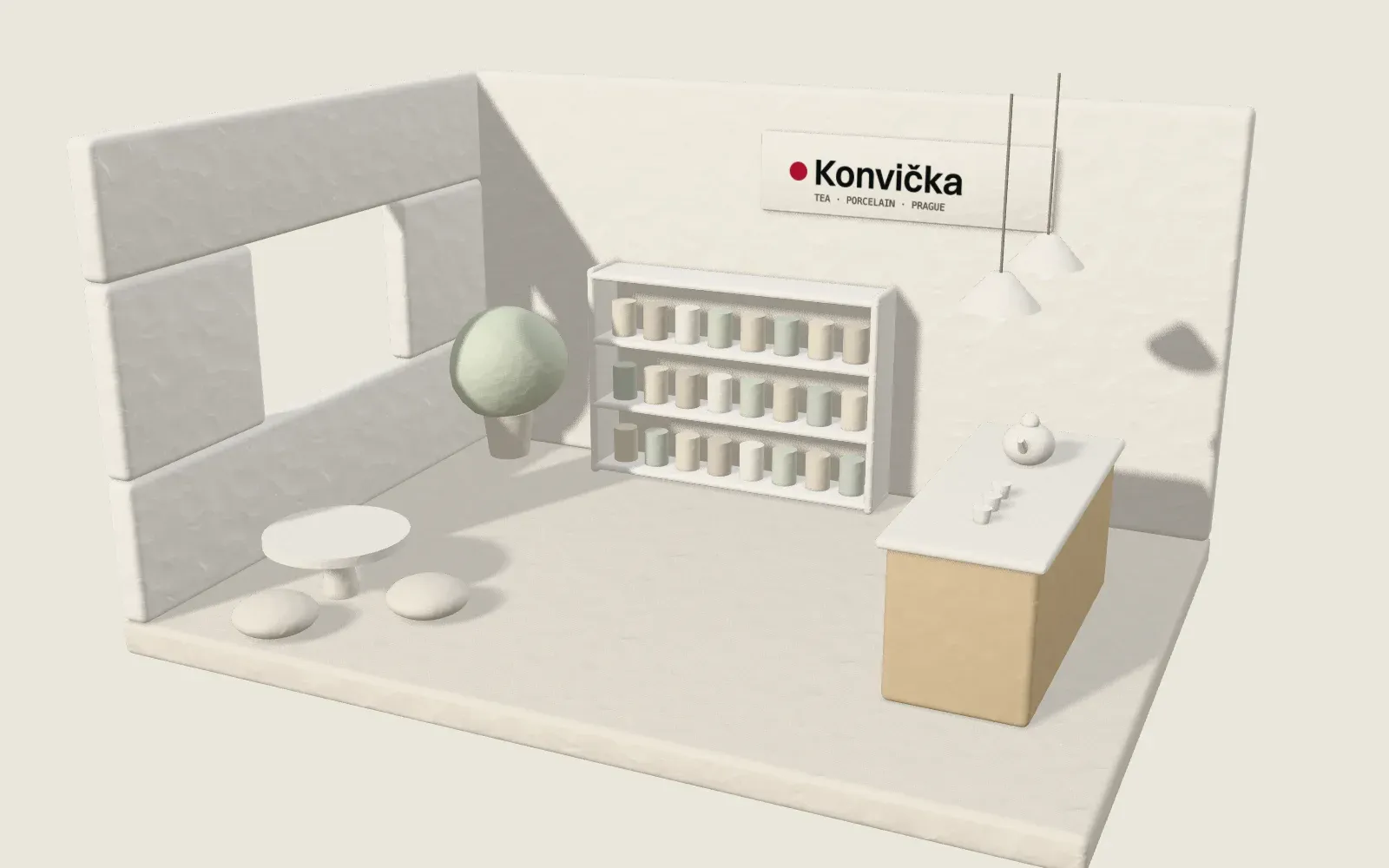
…/store?counter=oak&shelves=wall&light=day
Enhanced render: the same room and the same choices, made to look like a photograph.
Walk it at eye height.
A link opens the room as you'd walk in, at 1.6 metres, on a desktop or a phone, touch included.
Every open question, in the room.
Fourteen design questions from the brief, each with its options in place and the as-built answer beside the proposal.
Every answer is a link.
Whatever is chosen lives in the address, so a question can be sent as a link to its answer. A link for a client never offers editing.
Five shops, built from data.
Each shop is a file of measurements, with 1,100 to 1,700 objects per room and the goods placed by rule. One is the pilot unit, rebuilt at the size measured on site.
Light that's already done.
The light is baked ahead, one map per shop, so the room walks smoothly where live lighting crawled.
Enhanced render.
Any view can be finished to look like a photograph. Type, prices and dimensions come back from the 3D model, so nobody measures anything off an image.
For the retail chain, design reviews ran on pictures from the 3D instead of renders made one at a time.
- 01
From minutes to seconds.
Rendered the usual way, a frame took 2 min 20 s. From the browser, a full-quality still takes 8.1 s.
- 02
Review pages.
Each round went to the client as a page of views from the 3D, with the open questions beside them.
- 03
The final look.
For the final look, every view switched between the 3D model and its enhanced render.
- 04
The pilot unit.
Rebuilt in October 2026 at the size measured on site.
03— Under the hood
A faithful port.
The room moved from the modelling tool to the browser and was checked object by object, 407 of them.
A meter that measured the wrong thing.
The frame meter was timing the wrong part of the frame. Fixed, the numbers told the truth, and the work went where the time really went.
Eighteen lights at zero.
Eighteen lights were still being computed at zero brightness. Baking the light removed the cost of all of them.
Walking on an iPhone.
Phones have no pointer lock, so walking on an iPhone needed its own touch controls.
Where it is now
In use for the retail chain's stores. The shop on this page is made up: change the counter, the shelves and the light, then press Enhanced render.